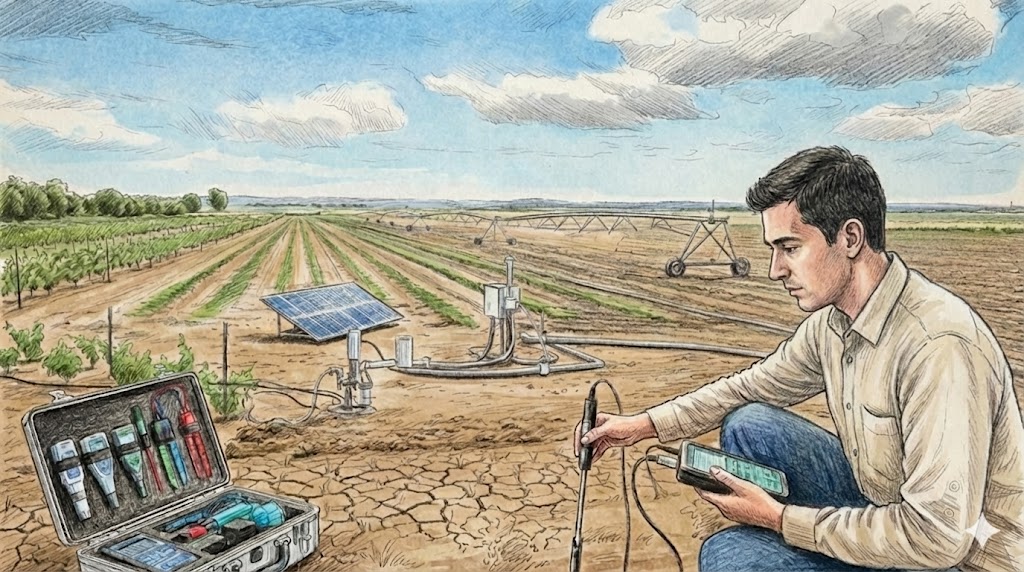
For a resilient, smart, and sustainable rural engineering
Rural engineering, a discipline at the heart of agricultural and rural development, is undergoing a period of unprecedented transformation. At the intersection of climatic, technological, and societal challenges, it must reinvent itself to address the stakes of the 21st century: accelerated climate change, chronic water stress, the imperative of food sovereignty for a growing population, and the digital revolution driven by artificial intelligence. Morocco, facing a decade of recurring drought, is dealing with the progressive depletion of its already limited groundwater resources and the tangible effects of global warming; rural engineering can no longer settle for traditional approaches. It must become a catalyst for resilience, innovation, and sustainability.
Rural engineering stands at a historical crossroads. The challenges are immense: climate disruption, chronic water stress, demographic pressure, and the transformation of food systems. However, the opportunities match these expectations. A new paradigm is emerging—one that no longer settles for mere techniques but embraces a systemic vision integrating artificial intelligence to multiply analysis and optimization capabilities, the ecological transition as a guiding principle rather than a constraint, local knowledge in constant dialogue with innovation, citizen participation to co-construct solutions, and climate resilience through anticipation and adaptation.
Beyond the technical dimension, 21st-century rural engineering must tackle major systemic challenges. Engineer training must evolve radically to integrate an unprecedented spectrum of skills, combining classical hydraulics, agronomy, ecology, data science, artificial intelligence, sociology, and environmental economics. Curricula must massively integrate digital tools and AI, include mandatory modules on climate change and eco-engineering, prioritize transdisciplinary project-based learning, and organize immersive internships in rural areas to understand social realities. Future key skills must include systemic thinking to understand complex interactions, data mastery for collection, analysis, visualization, and decision-making, emotional intelligence to work with communities and mediate conflicts, as well as creativity, innovation, and a strong ethics integrating social and environmental impacts.
Tomorrow's rural engineering should no longer be based on large infrastructures imposed from above, but on multi-scale, flexible, adaptive, connected solutions that respect ecosystems and societies. A rural engineering that reconciles productivity and sustainability, tradition and innovation, technique and ethics. Engineers will be facilitators of transitions, dialogues, innovations, and resilience. Armed with AI and digital tools, and anchored in ecological and social reality, they will be the architects of truly sustainable rural development.
However, this ambition requires a radical reappraisal. Current training for rural engineers, inherited from early 2000s paradigms, now shows a concerning lag behind contemporary issues. Designed in a context where climate change seemed distant, artificial intelligence was science fiction, and ecological transition was merely one option among many, this training can no longer claim to prepare professionals for 21st-century challenges. A complete and bold overhaul is required—not through simple adjustments, but through a full reconstruction of curricula, pedagogical methods, and target skills. Only such a transformation will allow this training to regain the prestige and relevance that made its greatness, and to train the engineers that rural Morocco needs to face the coming climate, water, and food challenges.
The challenge is immense, but inaction would cost infinitely more. Each year of delay in climate adaptation, agroecological transition, and digitalization further deepens the water deficit, degrades soil, and weakens agricultural systems. If Morocco succeeds in this transition, it will become a model for other countries facing similar challenges—a living laboratory where millennial-old 'khettaras' coexist with artificial intelligence, ancestral knowledge with cutting-edge research, and community solidarity with technological innovation.
Governance and participation constitute another fundamental pillar. Top-down approaches where engineers design and users execute have shown their limits. Co-construction with local communities is now recognized as a key success factor. Participatory diagnostics involve farmers and communities from the needs-identification phase, digital consultation platforms facilitate debate and collective decision-making, community management progressively transfers infrastructure responsibility to user associations, and a dialogue is established between traditional local knowledge and scientific technical innovation. The solution also lies in the total involvement of stakeholders at all levels (design, implementation, and infrastructure maintenance).
Rural engineering is not finished; it is reinventing itself. And in this reinvention lies an essential part of the future of rural Morocco, its food sovereignty, and its climate resilience. The time is no longer for half-measures but for boldness, creativity, and collaboration. The time is for an augmented, ecological, intelligent, and inclusive rural engineering—one that builds but also regenerates, produces but also preserves, and innovates without ever forgetting the human and the living. The future of rural engineering is being written today, and it looks promising for those who dare to shape it with lucidity, ambition, and responsibility.
Document drafted on January 12, 2026
For a resilient, smart, and sustainable Moroccan rural engineering
Ali HAMMANI
Author • posts
Discussion
Join the conversation
Join the discussion
Sign in to share your thoughts
No comments yet
Be the first to share your thoughts on this article!